Across Aotearoa, primary schools are exploring creative ways to use the recently expanded Classroom Release Time (CRT) allocation to enrich student learning. Many schools are employing specialist CRT teachers (e.g. art, technology, science) to provide learning in areas that students might not otherwise be exposed to. One area gaining momentum in the Waikato is environmental education – with schools employing specialist enviro teachers to provide hands-on, place-based, culturally grounded learning that deeply engages tamariki.‑on, place‑based, culturally grounded learning that deeply engages tamariki.
A recent webinar hosted by Enviroschools Waikato showcased how several schools are using CRT to deliver meaningful, whole school environmental programmes like Enviroschools. What emerged was a set of powerful themes: safety, belonging, culture, student agency, and the transformative power of outdoor learning.
Below is an overview of what these schools are doing, and what’s possible when leadership supports specialist roles and trusts teachers to innovate.
Why Environmental Education works so well in CRT
Across all schools, certain themes were present:
- High engagement and almost no behaviour issues
Whether gardening, building shelters, weeding a gully, or crafting with harakeke, tamariki were described as settled, focused, and happy. Teachers reported that even students who struggle in the classroom often thrive outdoors.
- A safe and inclusive space for all learners
Hands-on, sensory-rich learning supported neurodiverse and high-needs learners remarkably well. Several teachers said they often didn’t need teacher aides during outdoor sessions — the work naturally regulated students. Teachers with dedicated classrooms reflected that they provided ‘safe spaces’ for students to explore their passions.
- A natural way to integrate te ao Māori
From maramataka-aligned planning to local pepeha, gully restoration, and māra kai, schools used environmental learning to authentically embed cultural responsiveness.
- Whole-school ownership and participation
Schools found that when environmental learning is built into CRT, every child becomes an ‘Enviro Kid’. Tasks such as composting, recycling, worm farming, or planting are understood and shared schoolwide, with systems being integrated into the school day.
- Leadership support is the catalyst
Every success story began with a principal who said: “Yes — give it a go.”
Some challenges highlighted by schools included
- Weather and seasonality — sessions often needed backup plans, flexibility, or quick adaptations.
- Switching between year levels (e.g. from Year 6 to New Entrants in the same day) required constant adjustment in teaching style, expectations, and differentiation.
- Limited time for planning, prepping spaces, and maintaining systems like composting or gardens meant teachers often felt stretched.
- Teacher engagement wasn’t guaranteed — some staff were hesitant or lacked confidence to take learning outdoors without support.
- Space constraints or shared areas (e.g. gullies with public access) created logistical issues, including vandalism or damage.
- Resource availability (tools, expert support, specialist equipment) could be inconsistent or limited for some schools.
Spotlight on the Schools
Bankwood School
Bankwood School has a role of approx 350 students and is located in a diverse community in the northeast of Hamilton City. Rachel, a specialist science and environmental CRT teacher, runs full-day sessions in her dedicated classroom.
Rachael teaches Enviroschools Learning and Pūtaiao through a te ao Māori lens. Her seasonal planning aligns with the maramataka, and is based around the school’s localised curriculum. The school has a strong connection with the local Kukutaaruhe Gully and makes use of local experts including Fairfield Project and Kids In Nature (Hamilton City Council’s in-school programme). House of Science resources are also used.
Rachael says “every day is an enviro day, and every one is an enviro kid” – all students get to take part on the enviro projects and mahi, not just the enviro group members. Some days a class can spend almost the whole day outdoors! Teachers are kept in the loop with google slide-decks and keynotes. Extra resources for science / enviro theme days are also shared with teachers throughout the year.
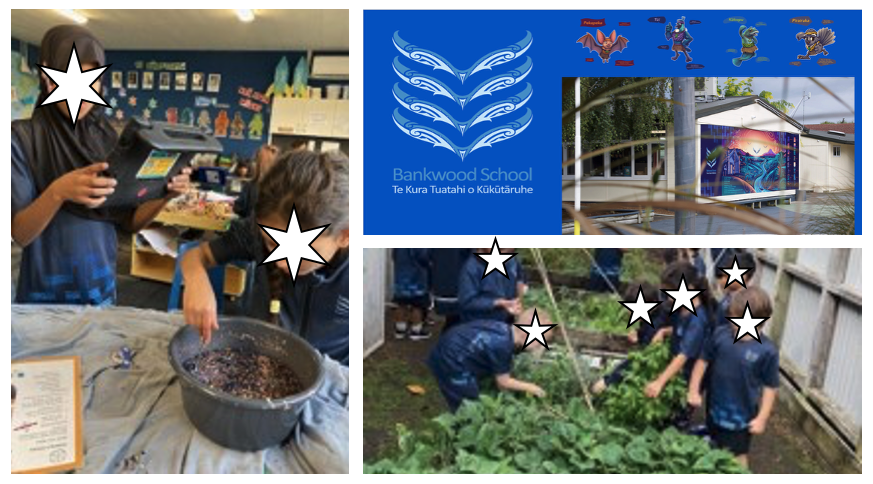
Whole school involvement in enviro actions at Bankwood school
Whareorino School
 Deborah brings a wealth of experience to this school, from running an enviro-science classroom in a large urban school to completing a PhD on incorporating edible gardens in schools to reinforce both cultural and educational learnings. She now works two days a week in the country’s smallest school (just six students), teaching environmental education and gardening.
After years of running lunchtime envirogroups and trying to cram all the jobs into breaks, Deborah approached her principal at Dawson School (Auckland) and “let’s just try this, let’s have a dedicated (enviro) classroom”, with a view to bring more science and enviro into the school day. From there, her role took a similar shape to Rachael’s at Bankwood, providing CRT cover (approx 90 mins at a time) for New Entrants to Year 6.
Her classroom became a safe space for disregulated students, who were often passionate about the topics offered. She refers to these students as her ‘Warriors’, and watched them flourish through responsibility, routine, and shared kai. “I never had a minute’s trouble with those boys… first time they planted a tree they had to plant it three times… (but) they became experts, they were wonderful.”
Insoll Avenue School
Insoll Avenue School has a role of approx 350 students and is located in the eastern suburbs of Hamilton. Toni stepped into the Enviro Lead position at Insoll Avenue School a couple of years ago, and uses her role as CRT and ORS teacher to energise the entire school community. In this time she has established two Enviro clubs (junior + senior), created new systems for composting, paper recycling and sandpit care.
Toni has her own classroom, with students coming to her for half days. She teaches Years 0-6, which can lead to challenges switching thinking between age groups through the day! Planning based on the seasons, with a focus on hands-on projects. Working in gully space (planting and weeding) has been a hit, with all age-groups taking on some responsibility and care for the space. “They love it, you don’t get any behaviour issues, they just all want to get involved.”
Toni has been actively encouraging involvement from her colleagues. The new systems are now managed by various classes – “the students are the experts”. This has led to a lot of ownership and authenticity – “everyone gets exposed to enviro and they take it back to their classrooms and share with their teachers”. Challenges like time and weather persist, but the school now has school-wide ownership of sustainability.
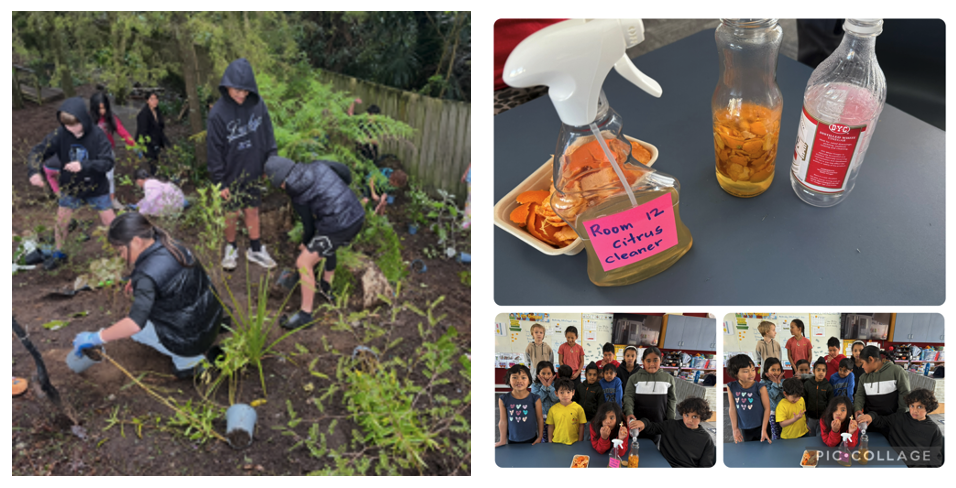
Hands-on projects engage all students at Insoll Ave School
Te Awamutu Primary School
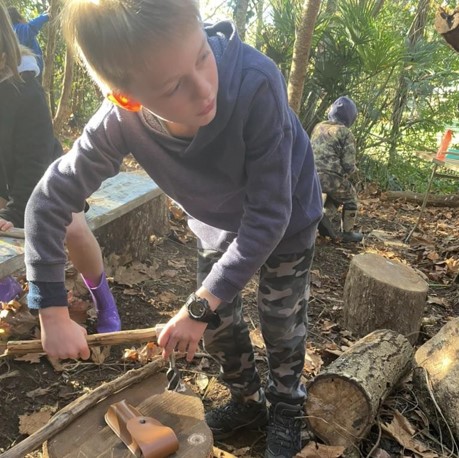
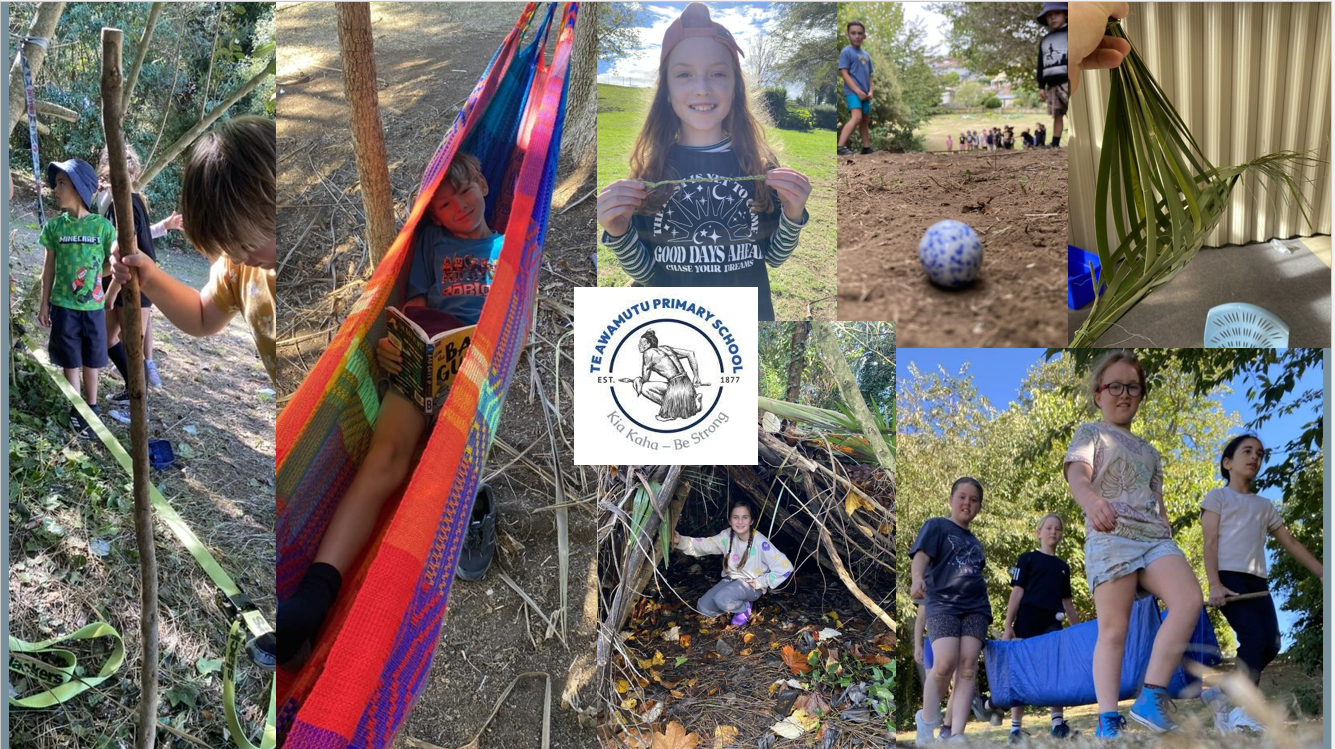
Te Awamutu Gully School
Mitch was hired to start a gully school programme on a patch of bush behind the school. Working with all 626 students, from New Entrant to Year 6, he delivers sessions that include:
- Safety briefings and tool use
- Confidence moving through the space
- Bushcraft
- Tarps, knots, shelter building
- Cabbage-leaf weaving, leaf art, stick whittling (cabbage tree leaf?)
- Orienteering and compass skills
- Predator control and biodiversity learning
The programme runs every day, regardless of weather, with each class getting 1-2 sessions per term. Links to the curriculum include Health & PE, Science and Oral Language.
Prior to this programme starting, the school sent some students to external Nature Schools. School leadership wanted to bring this opportunity in-house, and offer it to all students. Attendance is extraordinarily high – even among students who often stay home. “Some of the children that show (undesirable) behaviours in class are the most onto it down there.” While vandalism, foot traffic, and weather create challenges, the benefits far outweigh the obstacles.
Key lessons for schools interested in doing this too
- Start small – A few tarps, ropes, buckets, or garden beds can lead to a full programme.
- Use your place – Whether you have a gully, a courtyard, or a small garden — every space can become a learning space.
- Bring in experts – Enviroschools, council educators, and local hapū can offer support, gear, and knowledge.
- Build teacher confidence gradually – Co-teach, model sessions, or invite staff to observe. Enthusiasm spreads quickly.
- Prioritise relationships and wellbeing – For many teachers, environmental CRT became a powerful pastoral tool.
Increasing CRT provides a rare opportunity to rethink what specialist teaching can look like. The teachers in this webinar were clear – Environmental CRT roles transform schools. They can build belonging, grow student agency, and create calm, purposeful learning environments.
 Print
Print