This case study continues from a previous case study: Zooming in on Nature: Enviroschools Facilitation for Remote Schools. Whareorino School is a small, remote rural school deeply engaged in the Enviroschools Kaupapa. With students ranging from new entrants to Year 8, learning happens collaboratively; with older students taking on leadership roles and younger students contributing curiosity and creativity. Supported by enthusiastic school staff and regular remote Enviroschools facilitation, students engage in meaningful, student-led environmental inquiries that lead to sustainability action and a strong sense of belonging within the wider Enviroschools movement.
Over the past two years, their Enviroschools facilitator, Cami, has been engaging with the school and has seen the broadening and deepening of their sustainability journey, grounded in connection to place and student agency. Students are supported by an incredible Garden to Table and Enviroschools teacher, Tepora Davies, who brings a wealth of gardening knowledge and experience, alongside the school’s committed and supportive principal, Wendy Payne.
A defining feature of this journey is the way learning happens across ages, with students supporting, teaching, and learning from each other. While not wanting to minimise how this creates a need for teachers to develop creative and highly adaptive teaching programmes, this multi-level environment has led to beautiful outcomes in terms of sustainability learning and action.
At one point in 2025, Whareorino School had a roll of just three students. In the second half of the year, the roll more than doubled to seven, with students spanning from new entrants through to Year 8. This wide age range offers many strengths in learning for sustainability, with older students naturally taking on leadership roles, modelling skills, language, and thinking, while younger students bring curiosity, creativity, and fresh perspectives.
Deep, Student-Led Inquiries
Throughout the year, students engaged in a series of deep, student-led environmental inquiries. One significant inquiry was Water for Life. Students began by mapping the school’s water sources, how water is used, and where it goes after use. They explored ways to use precious water resources as efficiently as possible and developed a shared understanding of water as a taonga.
As part of this inquiry, students created rain gauges and monitored rainfall across summer and autumn. As the inquiry deepened, students developed a project to harvest rainwater for their flourishing māra kai (food gardens). They also wanted to investigate the health of the stream that runs beside their school, planning a stream study to better understand the local freshwater ecosystem.
Unfortunately, extreme flooding events during the year meant the planned stream studies had to be postponed.
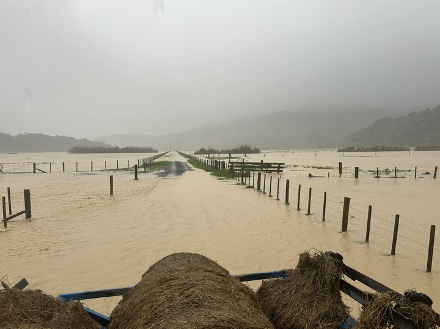
The flooding was severe, with all roads blocked and the community isolated, at times without access to electricity or new supplies for extended periods. During this time, the strength and resilience of the Whareorino community was clearly visible, with neighbours sharing resources, community members using personal equipment to clear roads, boats being used to move around flooded areas, and people working collectively to look after one another and their livestock.
While these experiences highlighted community connection and resilience, the delayed and minimal external support also drew attention to some of the unique and specific challenges faced by remote, rural communities. As someone outside of, but with connection to, the Whareorino community, this led Cami to reflect on what resilience and community flourishing will look like in the future (especially as climate change brings more frequent and intense weather events), and how district, regional, and national organisations can offer better support. (Image source: Whareorino School Facebook Page)
Remote Facilitation That Strengthens Connection
As a remote rural school, in-person facilitation opportunities are limited. Instead, Cami mainly connects with Whareorino students through short but regular Friday morning Zoom sessions. During these sessions, students share the kaupapa they have been exploring that week and identify next steps for the week ahead. This approach has supported several inquiries in 2025, including Water for Life, a pest management investigation, and a place-based project focused on the Whareorino Tunnel.
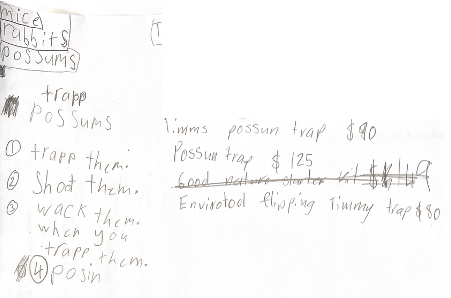
Through the pest management inquiry, students explored local pest issues, impacts on native species, and different approaches to pest control. Students were paired roughly by age, with each pair investigating options for managing one of the main pest species they struggle with at school. This inquiry directly informed later action at the school, including planting lavender as a natural mouse deterrent (junior pair), setting up rabbit-proof vegetable gardens (middle pair), and organising the installation of automatic possum traps (senior pair).
In-Person Facilitation Whenever Opportunity Arises
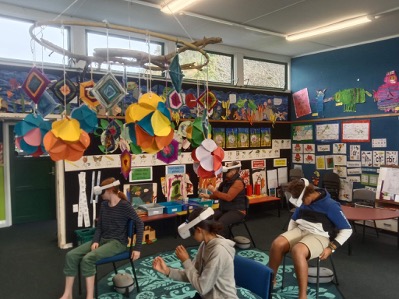
Kauri Protection at Taranaki Enviroschools ‘Enviro Day’
In June, Taranaki Enviroschools organised their annual Enviro Day, hosted at Ahititi School. This event provided an opportunity for Whareorino students to connect with four other local Enviroschools, to learn together, and to see sustainability kaupapa explored in different contexts. The day was full of fun activities (bug hunting, soil sampling, bird egg identification, kauri protection, and learning local Indigenous stories), and Cami was really excited to be invited to run a session. Inter-school events are a brilliant way to build a sense of belonging to the wider Enviroschools movement.
In December, Cami visited Whareorino School for activities, reflection, and celebration. Students chose to make it a pyjama party day, adding an extra layer of fun (and some curious looks when Cami stopped for fuel along the way).
On arrival, students were mid-Zoom call with Whaea Tepora, which was particularly amusing, as usually it is Whaea Tepora in the room and Cami on the screen. After the call, students proudly showed their māra kai, and together everyone “tickled” potatoes to harvest them (the potatoes were boiled and served with lunch – yum!).
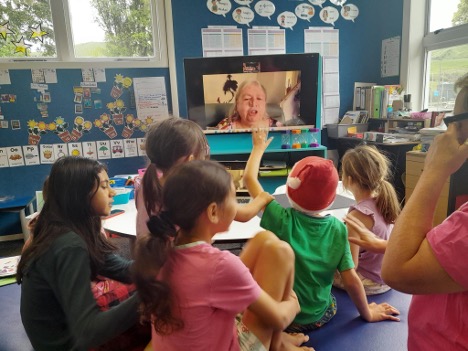
Role reversal – this time it was Whaea Tepora on the screen and Cami in the classroom!
After morning tea, students planted lavender around the kitchen window and entrance, an action developed by the ‘mice management’ pair during their pest management inquiry.
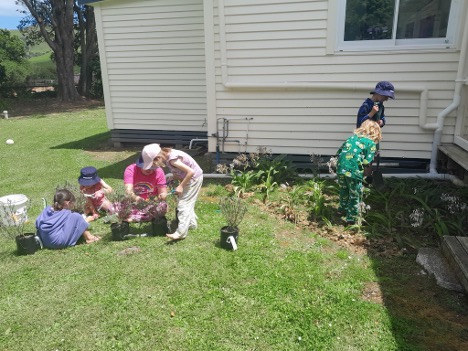
Planting lavender to repel mice. The lavender was dead-headed before planting, with flowers collected and discussions sparked about making lavender “essential oil” as another possible natural deterrent.
Lunch followed, with delicious kai prepared by Ka Ora Ka Ako, Lunch in Schools Coordinator, Haylee. Afterwards came an intense game of four square, requested by Cami, who had first learned the game during the previous year’s visit and hadn’t played since. The afternoon continued with story time using a choose-your-own-adventure book set in a forest, followed by
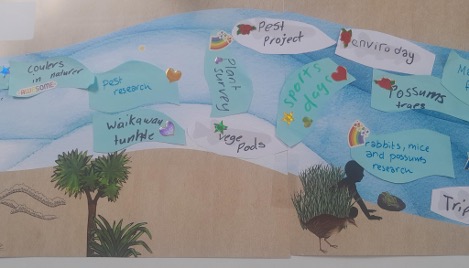
A section of the kato kōrero reflection activity
reflection and celebration.
The reflection took the form of a kato kōrero activity, where students wrote down their sustainability learning, actions, and highlights from the year (and there were many!), as well as new ideas and kaupapa they wanted to explore next year. The final result was a beautifully full awa illustration, covered in words, ideas, and stickers, representing the flow of their learning journey.
The day ended with an Official Silly Dance on the lawn, the presentation of a beautiful hand-drawn collage book created by all the students for Cami, and many hugs. Cami’s reflection was that through having regular connections with students throughout the year, coming together in person is simultaneously extra special and low-pressure: most of the learning and mahi has already taken place, so the in-person visits can focus on bringing it all together – celebration, connection, and having fun gardening in your pyjamas!
 Print
Print