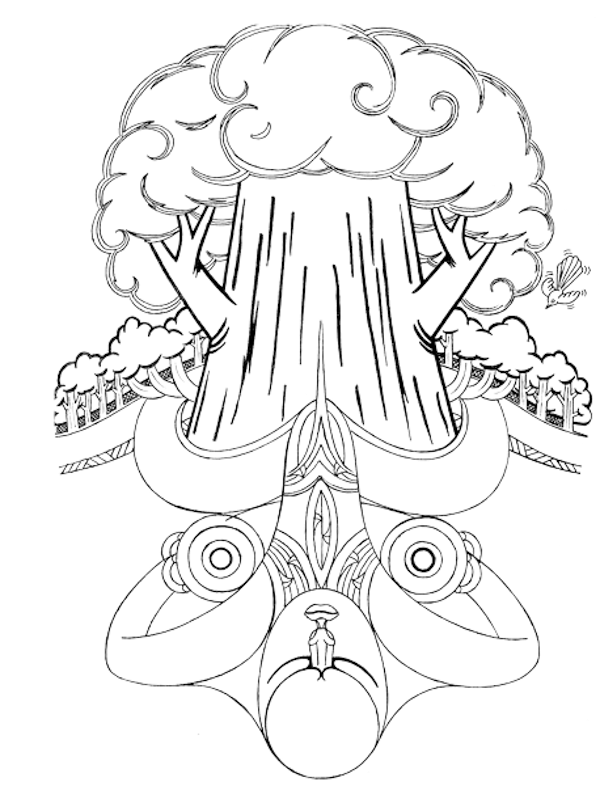
Tãnemahuta
The forest and all the dwells in it
Growth, strength, shelter, diversity of life
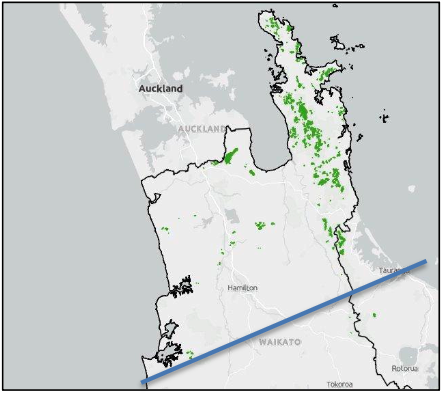 “What do you think the green patches on the map represent?” asks the Enviroschools facilitator to the class. The class falls silent.
“The green patches show where mature kauri live in the Waikato. We know this from flying drones and small planes over forests to identify kauri. We have 94,000 hectares of healthy kauri growing in the Waikato,” says the facilitator. “How cool is that! Do you know how we can protect these majestic, chiefly trees?”
Hands shoot up as students excitedly share their ideas for protecting kauri forests. How can you, we, everyone, protect our kauri forests? This call to action defines the Waikato Regional Council’s (WRC) Kauri Protection Experience – education that inspires protection of the significant kauri forests of the Waikato.
Whether you would like to bring this programme to your school or create a programme tailored to your region, read on.
The Current Situation
Where have we come from?
The WRC Kauri Protection Experience was first piloted in 2023 at Wairakei Primary School. The programme combines the immersive Kauri Pou Kaitiaki virtual reality experience, a Wētā Workshop designed education trailer, with curriculum-aligned learning resources developed in partnership with Waikato Enviroschools.
The programme was scoped by Enviroschools Facilitators Anna Cunningham and Jennifer Scothern-King and delivers essential key messaging and practical actions that help protect kauri. Since the pilot, the programme has reached 64 schools across the Waikato region. Underlying the success of the programme is the partnership between WRC’s Kauri team and Waikato Enviroschools. The WRC Kauri team provides specialist knowledge, coordination, resources, and funding, while the team of Enviroschool facilitators utilises its network to bring the learning to life in schools and at education events across the region.
 What have we learnt?
The original delivery model includes the education trailer, virtual reality and two facilitators. It is an engaging and highly interactive learning experience.
Feedback from schools and facilitators guided the next phase of development: creating a programme that was more flexible, accessible, and connected to curriculum learning. The following areas were identified for development.
- make greater use of existing resources and activities
- reduce logistical barriers and delivery costs
- adapt the programme for junior primary students and secondary schools
- strengthen curriculum connections
- collaborate with other environmental education programmes
This led to a creative rethink of the programme.
Explore Alternatives
To broaden our thinking and to consider different approaches, the team reviewed several bespoke programme deliveries. These included supporting Coromandel Area School senior students to investigate microorganisms and their interactions with the environment and piloting a single-facilitator model with Moanataiari Year 4 students ahead of their camp in the Kauaeranga Valley.
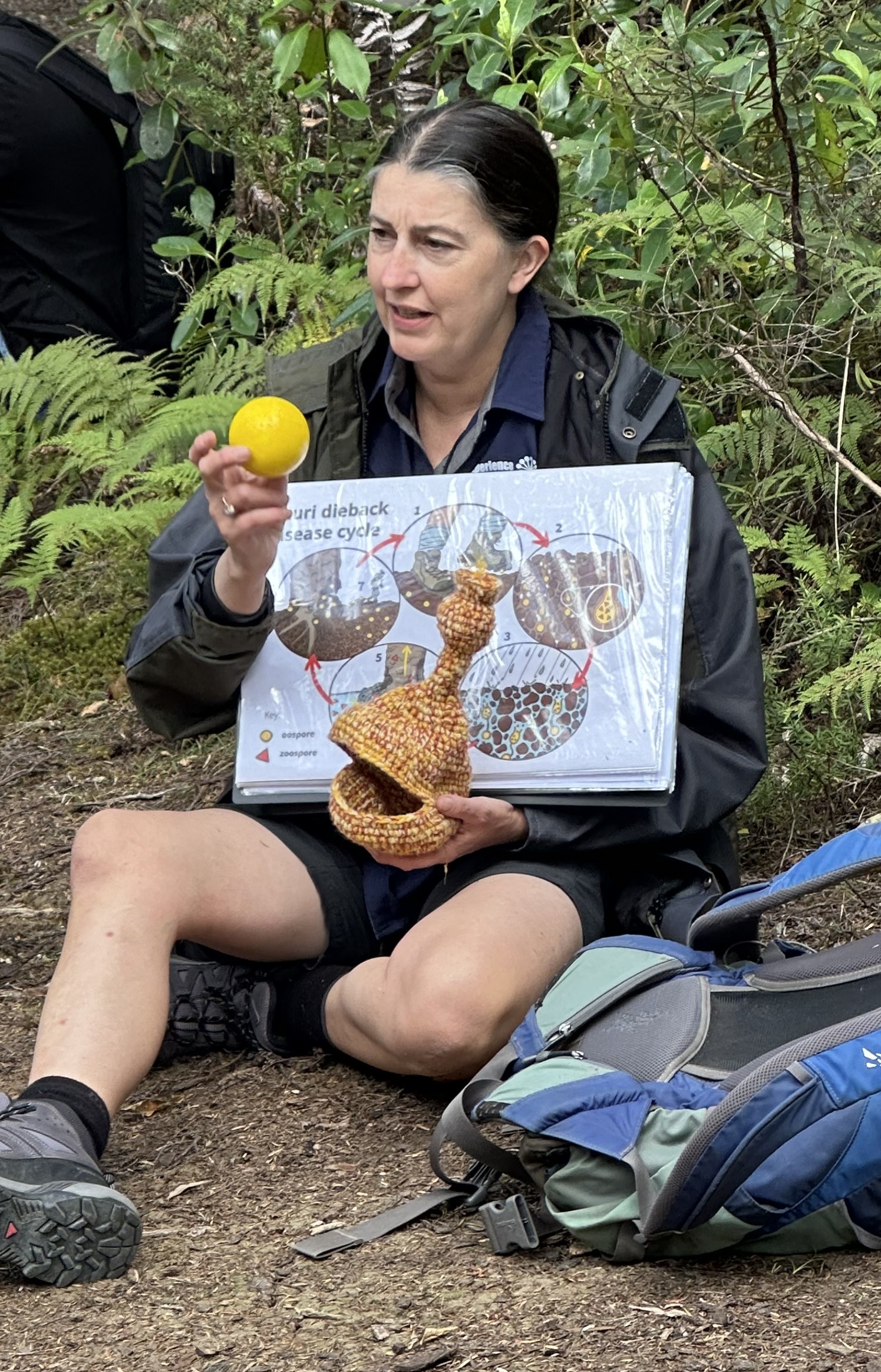
Auckland Sustainable Schools Advisor Virginia Best delivering kauri education in the Waitākere ngahere
An eye-opening experience for the team was observing members of the Auckland Sustainable Schools team delivering kauri education in the Waitākere ngahere. Their programme aligns with the science curriculum and supports Year 10 & 11 students to explore big ideas and significant learning through the practical application of kauri protection. The 70-minute session included a hīkoi along an old kauri logging line, learning about the causes and impacts of kauri disease, exploring approaches to managing this threat and concluding with students sharing their perspectives on how to best protect this national taonga.
What are our priorities for change?
Rather than create a new programme, the focus was on adapting existing resources to suit different contexts while elevating the kaupapa of experiential, action-based learning.
Taking Action
Over Terms 1 and 2 of 2026, the team developed and piloted several approaches across a range of schools and settings, exploring new ways to deliver the programme.
Single Facilitator Model
Facilitator Anna Cunningham led the streamlined version of the programme, which was piloted in partnership with Hamilton City Council’s Kids in Nature programme. The Hamilton East School Kauri Experience provided every Year 3–6 student the opportunity to participate as part of their Kids in Nature learning modules. With several mature kauri trees growing on the school grounds, the learning was deeply connected to place and provided a meaningful context for students. Over four days, approximately 320 students engaged in the programme.
Following this successful pilot, a resource kit has been carefully curated to support accessible delivery of the single facilitator model. This model involves the class teacher assisting with learning activities, such as sentence matching which reinforces desired behaviours, activity worksheets, and studying the pūrākau Tohorā and Kauri
Since then the single facilitator model was the preferred approach for delivery of Kauri education at Te Awamutu School and Forest Lake Primary.
Junior Programme (Years 0–3)
In response to requests from junior class teachers, the programme has been adapted to meet the needs of Year 0–3 students, recognising that the virtual reality component is not suitable for this age group. The following examples highlight some versatile approaches.
At Ruawaro Area Combined School, junior students enthusiastically participated in hands-on activities including boot cleaning, the species memory game, and Kauri Jenga. Through play-based learning, these activities help students understand the importance of protecting kauri. An outcome was for students to apply their learning by creating posters for the Department of Conservation’s kauri protection bunting, which are now displayed at the Kauaeranga Visitor Centre.
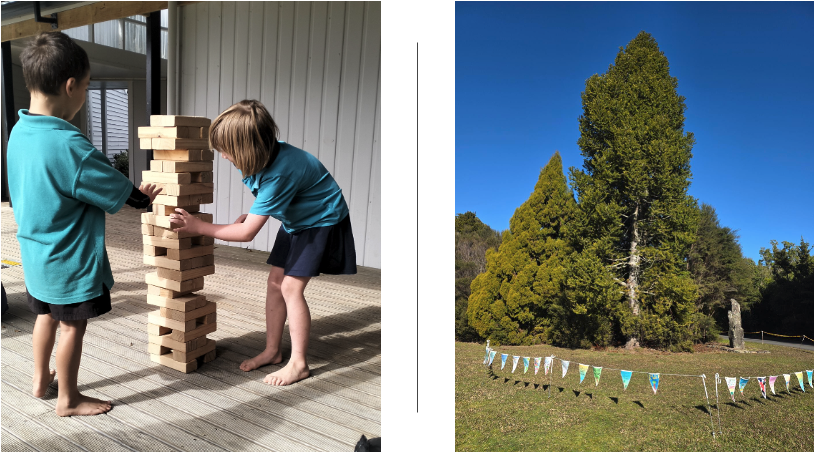
L: Ruawaro Area Combined School students playing Kauri Jenga; R: DOC’s Kauri Bunting at the Kauaeranga Visitor Centre
As part of the Waihi Central School junior sessions, the WRC Kauri team led an informative hīkoi through the school’s ngahere. This approach supported students to connect with their local environment while laying the foundation for understanding the importance of caring for our native forests.
Tuakau College Secondary School Pilot
To create Kauri Protection Education for secondary schools, the Waikato Enviroschools team drew on observations of the Auckland Sustainable Schools’ Kauri Programme based at the Arataki Experience Centre. While kauri protection education can connect to a wide range of curriculum areas, the focus for this pilot was narrowed to Year 9&10 Science and Social Science.
Using kauri forests as a real-world context, students explored ecosystem relationships, the impacts of human activity, and strategies to protect kauri and maintain forest health.
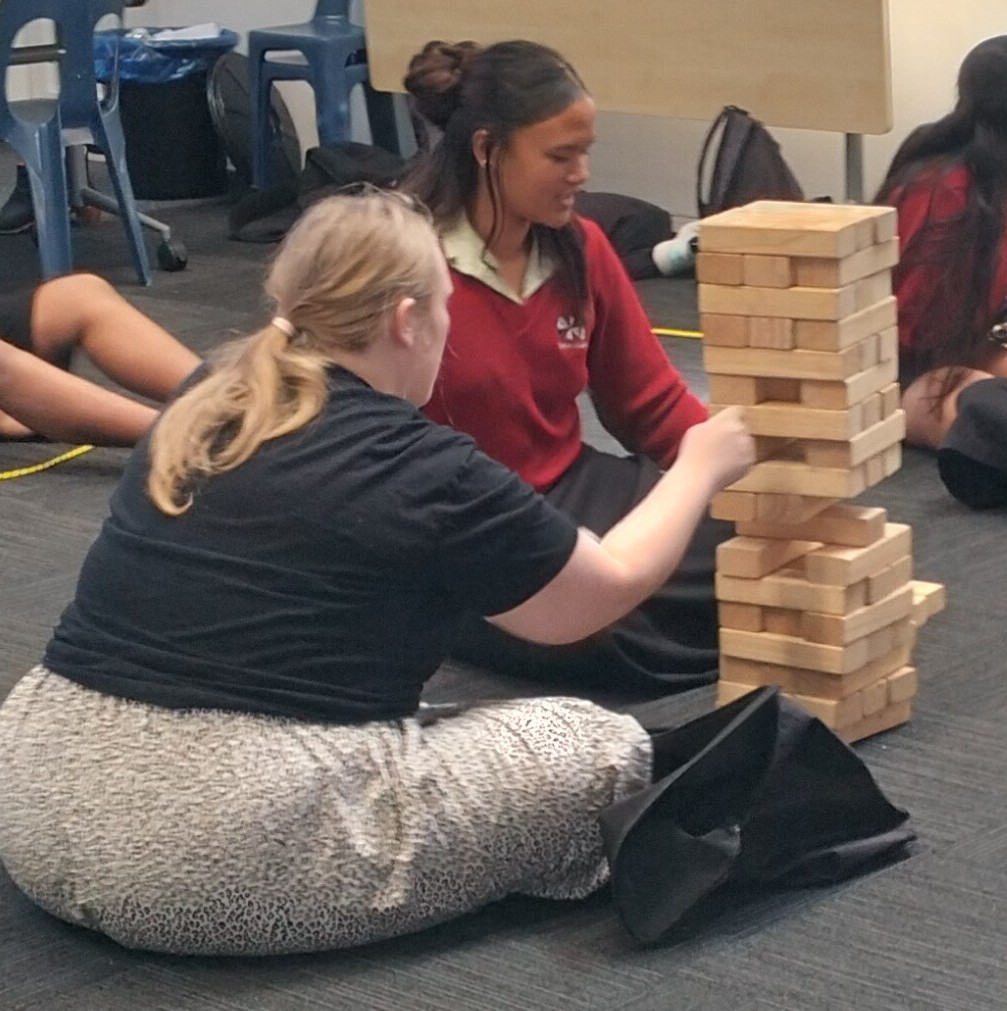
Enviroschools facilitator Gypsy Taylor-Hewitt explaining the Kauri Ecosystems Game to Tuakau College students
To captivate the attention of Year 9 & 10 students, resources were modified and extended, and the powerpoint was given a rest! Our Kauri Block Challenge was transformed into the Kauri Ecosystems Game where impact cards introduce a range of scenarios for students to discuss. Each roll of the dice determines how these events influence the health the ecosystem.
Kauri Pou Kaitiaki virtual reality is consistently a popular learning tool. During the post-experience discussion, the facilitator guided students to reflect on the species they had observed and then explore the connections between them. Students gained a practical understanding of ecosystem relationships and learnt that protecting kauri supports the health of the whole kauri forest.
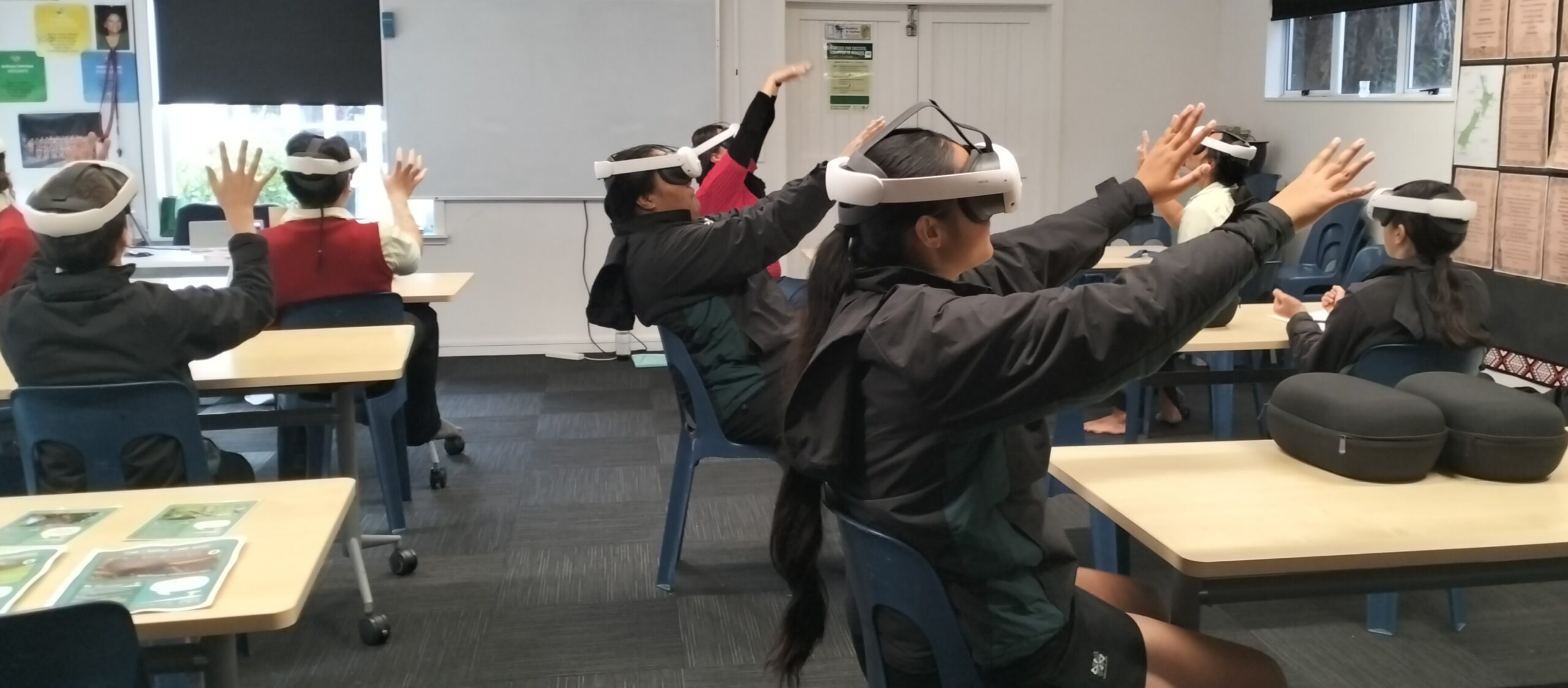
Tuakau College students experiencing the Kauri Pou Kaitiaki virtual reality
Full Programme
The original programme continues to be a very popular and a great way for the schools to be immersed in Kauri Protection education. Karapiro school was motivated to share their learning with their wider community. Check out the video they created.
For Matamata Intermediate, the sessions were perfectly timed before the school’s Waihi Beach camp, preparing students to explore and protect our local natural environment. Read more about their experience.
Field-Based Learning
For some schools such as Ngāruawāhia Primary School, the natural next step has been a field trip. Students put their learning into action, not only making sure their shoes were 100% clean before entering the ngahere but also staying on the track to experience mature kauri and a kauri ricker stand. The field trip was accompanied by a field journal creating a well-rounded learning experience.
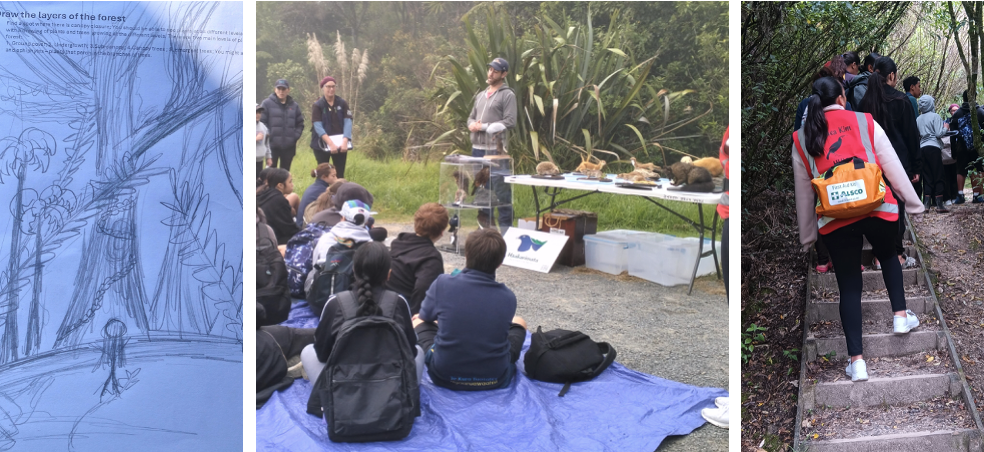
Ngāruawāhia Primary School field trip to the Hakarimata Range
Reflect and carry on!
The WRC Kauri Protection Experience has been engaging schools across the rohe to learn about this national treasure since 2023. This programme supports students to read, write, listen, play, learn, and have fun while learning how to practise kaitiakitanga and protect kauri forests. The programme continues to go from strength to strength – emulating the resilience and mana of the mighty mature Kauri trees.
The WRC Kauri team and Waikato Enviroschools continues to work collaboratively to refine and strengthen the programme. The focus over the coming 12 months is:
- To further develop the piloted secondary school offering.
- To refine the single-facilitator delivery model, including teacher instructions and self-directed learning resources.
- To review delivery processes to ensure the programme is consistently delivered to a high standard, with organised and engaging resources.
- To review pre- and post-learning resources to ensure they are accessible and aligned with the new curriculum.
- To explore further opportunities for field-based learning and local partnerships.
The success of the programme has inspired resources to be translated into te reo Māori with plans to start delivering into kura later this year. Could your school or students benefit from this experience? Could your region benefit from a similar education programme that helps protect a national treasure? To find out more, get in touch with the Waikato Enviroschools team.
 Print
Print